Hierarchical Bayesian inference
Behavioral Mapping of Hierarchical Dynamical Models Accelerates Bayesian Parameter Inference
Learning behavioral compatibility across hierarchical dynamical models to accelerate Bayesian parameter inference.
Project overview
Bayesian parameter inference for complex nonlinear dynamical models is often limited by the cost of repeated model simulation. We present a behavioral mapping framework that uses the inferred posterior of a higher-level model to accelerate inference of a lower-level model without requiring state or parameter correspondence between them.
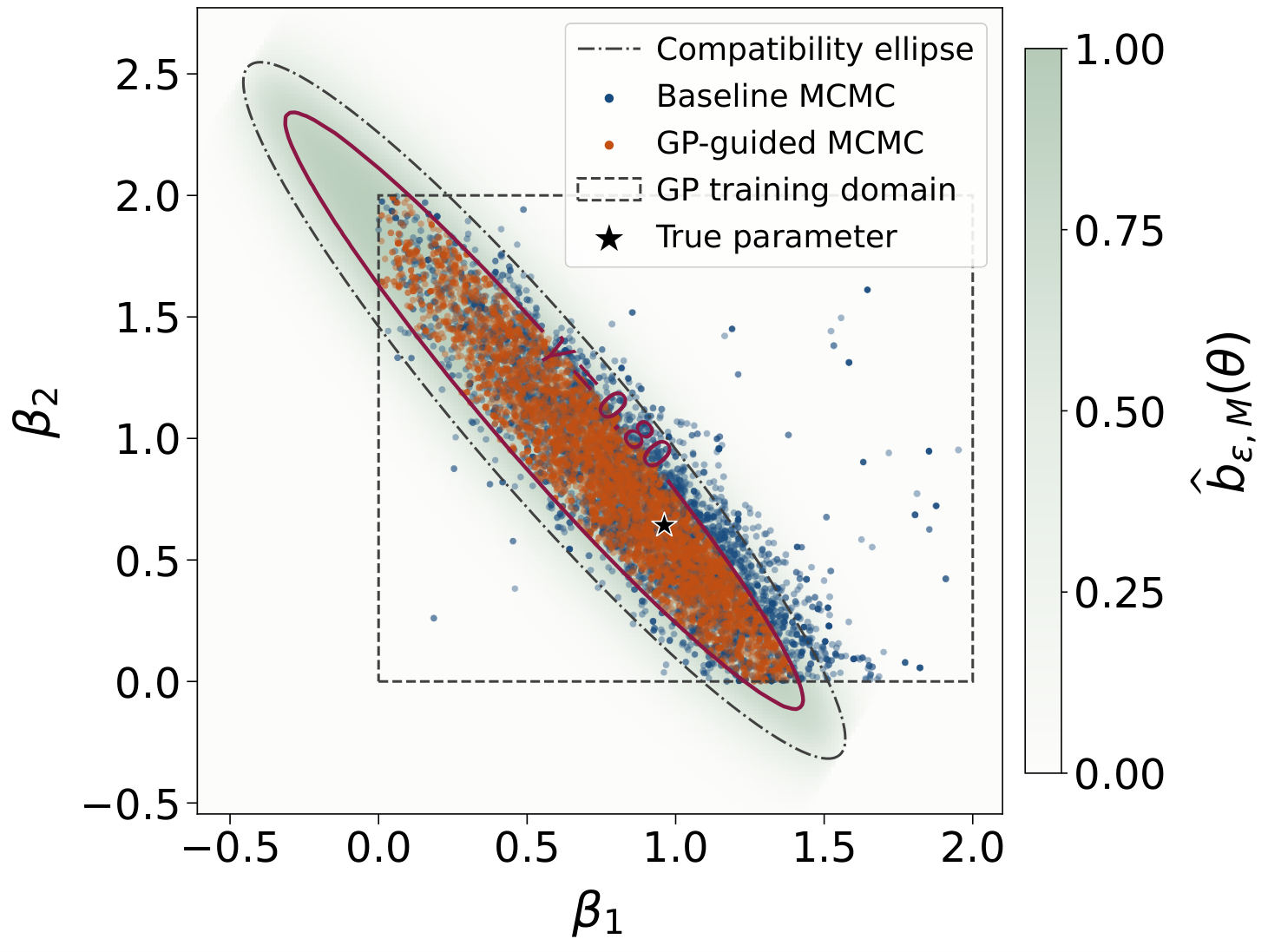
Building on approximate simulation relations for hierarchically related models, we define the notion of behavioral compatibility and quantify the behavioral support of detailed model parameters using the reduced model posterior. We learn a level set of behavioral support using a Gaussian process and use it to filter detailed model parameter proposals before expensive simulations during Markov Chain Monte Carlo (MCMC) inference. We derive conditions under which the behavioral support level set retains all detailed model parameters that fit the experimental data within a prescribed tolerance.
We apply this method to a hierarchy of gene-expression models fitted to cell-free experimental data. After initial setup costs, our approach speeds up MCMC by 8.02% for the phenomenological model and 15.21% for the mechanistic model.
Paper
-
Behavioral Mapping of Hierarchical Dynamical Models Accelerates Bayesian Parameter Inference
Jingsong Bai and Ayush Pandey. arXiv:2610.30683 (2026). DOI: 10.48550/arXiv.2610.30683.
Code
-
Hierarchical inference examples and methods
The hierarch-inf repository contains the linear-system example, hierarchical inference of phenomenological and mechanistic gene-expression models, and model construction with SBML export.
Current participants
- Jingsong Bai
Fetching last updated date...
The page consists of copyright material from publications that are either under review or published. Other than these, the rest of the content is free-to-use and can be shared with proper attribution. You can view the LICENSE here. You can contribute to this page by creating a pull request on GitHub.